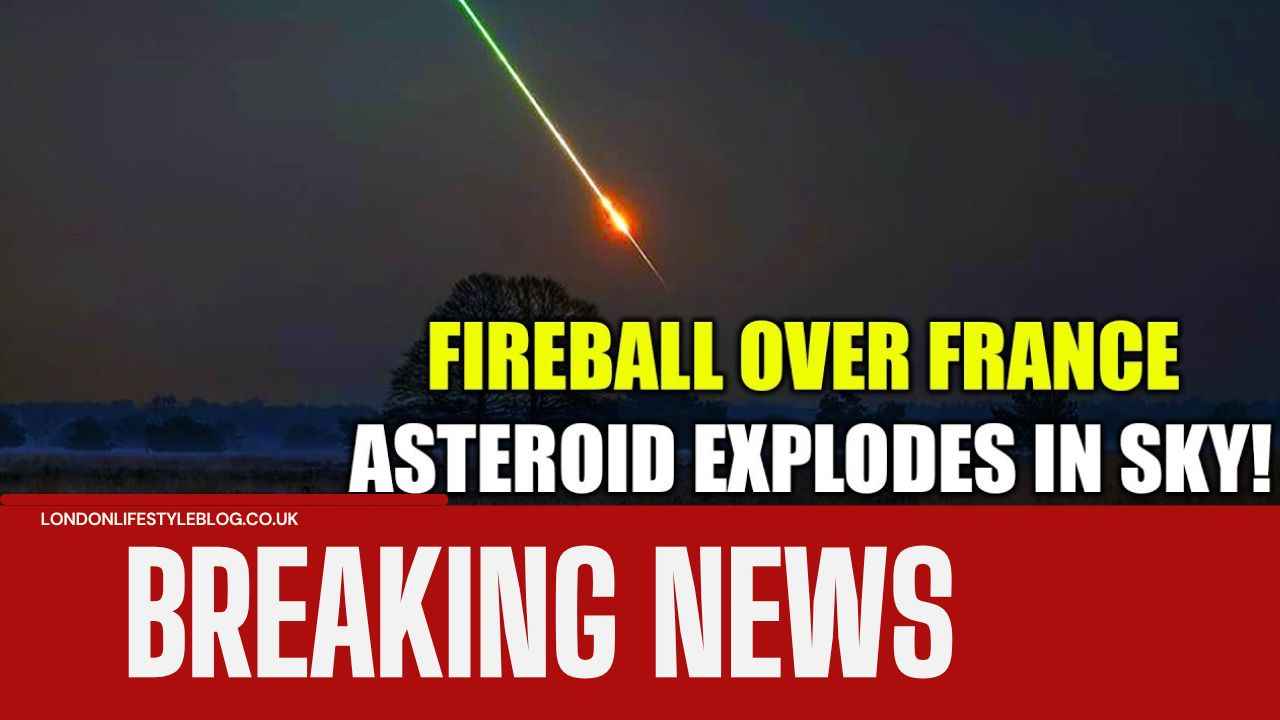
A fireball lit up the night sky in France on February 13, 2023. A small asteroid, named 2023 CX1, entered the Earth’s atmosphere, which was the cause of the fireball 2023 over France. It blasted over Normandy at an altitude of 28 kilometers, and the explosion was sudden and powerful. This phenomenon shocked scientists as it broke apart in an atypical way.
Scientists later confirmed that the asteroid 2023 CX1 held together under extreme pressure, which was the cause of its sudden blast. All of its energy was released in a single moment, which generated a powerful spherical shockwave. The impacts were far massive than the expectations for an object less than a meter wide.
The asteroid was first spotted about seven hours prior, measuring less than a meter in width and weighing over 1,400 pounds. The scientists were able to track the asteroid closely. Despite its small size, the asteroid carried the power of 29 tons of TNT.
Approximately 98 percent of its mass was lost within seconds of its explosion. Many witnesses across Europe watched the fireball and clicked photos and videos of the incident. The sudden release of energy amplified the danger zone on the ground.
The explosion was four times larger than models predicted, according to NASA scientists. Some fragments of the asteroids were later recovered in Normandy. Later, the fragments were identified as L-type chondrites. These are usual meteorites, but 2023 CX1 acted differently.
Only a handful of incoming meteors have been traced ahead of time, and two have yielded fragments later found on the ground. The second fragment fell in Germany in 2024.
The asteroids are rocky bodies that orbit the Sun, and they can range from a few meters wide to hundreds of kilometers across. On the other hand, meteoroids are much smaller and basically a fragment broken off from an asteroid.
The fireball over France was the seventh asteroid impact predicted before entry. Some earlier events include the 2008 TC3 over Sudan and the 2018 LA over Botswana. Each phenomenon helped the researchers in understanding how asteroids behave during atmospheric entry. It was a critical step for the preparation of larger impacts in the future.
The impact of asteroid 2023 CX1 was modest in size but profound in implications. Since it exploded and released nearly all of its energy in a blast, it released a new class of hazardous impactors.
Future planetary defense strategies should adapt to these instantaneous fragments, which are more common than previously assumed. Despite their small size, these fragments can still pose threats to more populated areas.
Subscribe to Updates
Get the latest creative news from FooBar about art, design and business.
Fireball over France: Sudden blast of asteroid 2023 CX1 poses new impact risks