


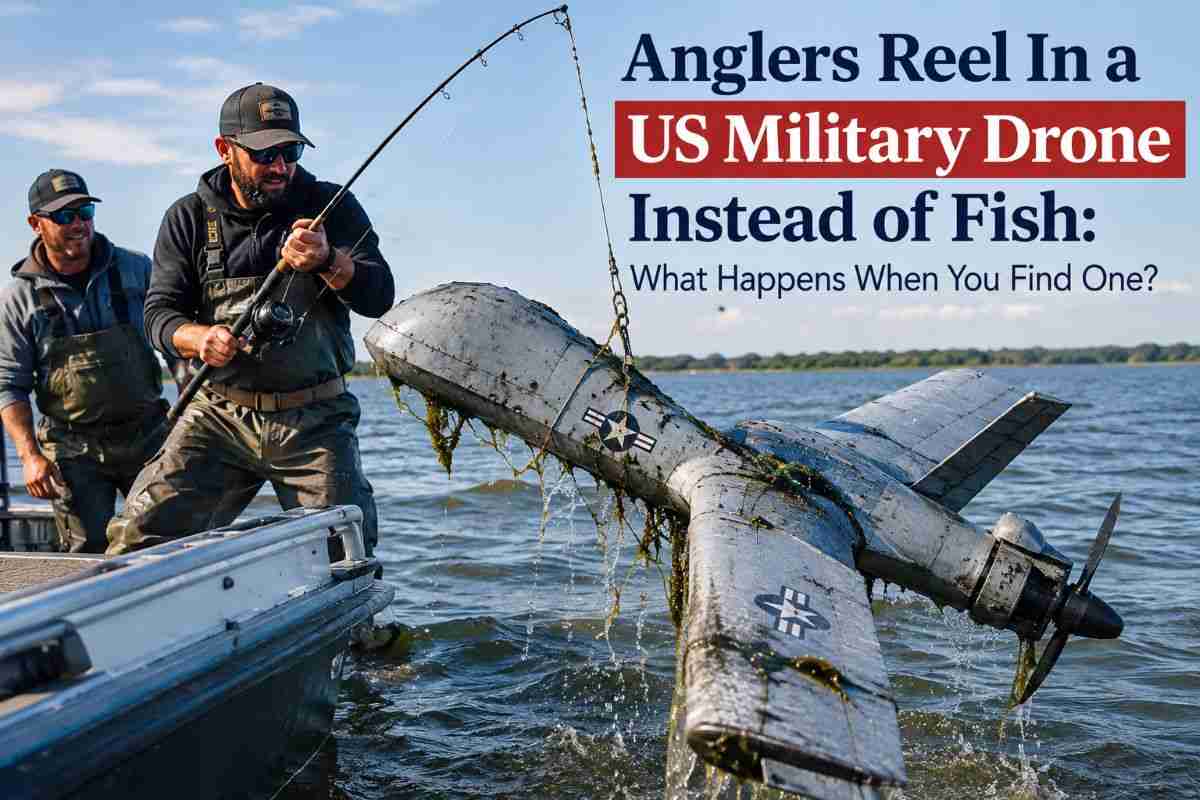
A fishing trip took an unexpected turn when anglers pulled a US military drone from the water instead of the catch they were hoping for. The discovery raises an intriguing question: what should you do if you find a suspected military drone, aircraft wreckage or other potentially sensitive equipment in the water?
For UK readers, the incident also offers a useful opportunity to understand how recovered drones are handled, why seemingly abandoned equipment can still matter, and when an unusual find should be reported rather than taken home.
What’s actually true: A drone lost during a military test
The discovery happened on 19 September 2026, when a fishing charter operated by Hot Spots Charters found a large unmanned aircraft floating in the Gulf of Mexico, off Florida’s Panhandle, near Eglin Air Force Base. The US Air Force subsequently confirmed that a drone had gone into the water during scheduled testing on 17 September.
Captain Daniel Arsenault and his passengers initially approached the object because they were concerned it might be a capsized boat. After realising it was an aircraft, they brought it aboard. The crew later handed it over to officials, and the charter reported that military representatives had collected it.
The aircraft was identified in media reports as resembling the FLM-136, associated with the US military’s Low-cost Unmanned Combat Attack System, or LUCAS. However, early reporting contained differing descriptions, and the Air Force’s initial confirmation did not publicly identify the specific model.
That distinction matters: the confirmed event is the recovery of a military test aircraft, while some of the more specific identification details came from media analysis.
How this connects to the wider question: Are military drones dangerous if they crash?
The Florida incident highlights a practical issue that extends beyond military testing: what happens when an unmanned aircraft comes down somewhere unexpected?
A drone can be an aircraft without having a person on board. Depending on its purpose, it may carry cameras, navigation equipment, communications systems or other technology. Military aircraft can also have components that are sensitive, damaged or potentially hazardous after a crash.
That does not mean every recovered drone is armed or presents an immediate danger. The condition and equipment of a particular aircraft matter, and photographs alone cannot establish whether it is safe to handle.
The LUCAS system has been publicly associated with one-way attack capabilities. However, that does not establish that the particular aircraft recovered by the anglers carried an explosive payload. The Air Force confirmed a test loss, not the complete configuration of the recovered aircraft.
For the UK, the relevant lesson is straightforward: an unfamiliar drone or aircraft wreckage should not be treated as an ordinary piece of discarded equipment.
Common misconceptions about recovered drones
“If it is floating, it must be harmless.”
Not necessarily. Water damage does not prove that batteries, electronics or other components are safe. Nor can a bystander reliably determine whether an unfamiliar aircraft contains hazardous materials.
“A military drone is always carrying a weapon.”
No. Military drones can be used for testing, training, surveillance or other purposes. Their appearance alone does not establish their payload or mission.
“If nobody claims it, I can keep it.”
Finding an object does not automatically give someone ownership of it. Military property, potentially dangerous items and objects connected with an investigation may need to be reported and handled by the relevant authorities.
What should UK readers do if they find a suspected military drone?
If you encounter an unfamiliar drone, aircraft wreckage or suspicious equipment on a beach, in a river or at sea, take a cautious approach.
- Do not touch or move it. Avoid opening panels, removing components or attempting to recover it yourself.
- Keep your distance. If there are signs of damage, exposed wiring, unusual odours or possible hazardous materials, move away and keep others clear.
- Report the discovery. In the UK, contact the police on 101 for a non-emergency report. If there is an immediate danger to life, call 999.
- Give authorities useful information. Explain where the object is, when you found it, what it looks like and whether anyone is injured. A photograph taken from a safe distance may help, provided you do not approach it to take one.
- Follow official instructions. Do not attempt to transport, sell, dismantle or dispose of the object yourself.
For incidents involving aircraft or possible aviation hazards, the appropriate response may depend on the location and circumstances. If you are at sea, contact the Coastguard through the appropriate emergency channel if there is immediate danger.
Key takeaways
The anglers’ unusual catch was linked to a US military test, rather than evidence of an unexplained drone incursion. The aircraft was recovered and returned to military custody, although not every technical detail was publicly established in the initial reports.
For UK readers, the practical message is simple: report unfamiliar aircraft wreckage, keep your distance and leave recovery to the appropriate authorities.
