


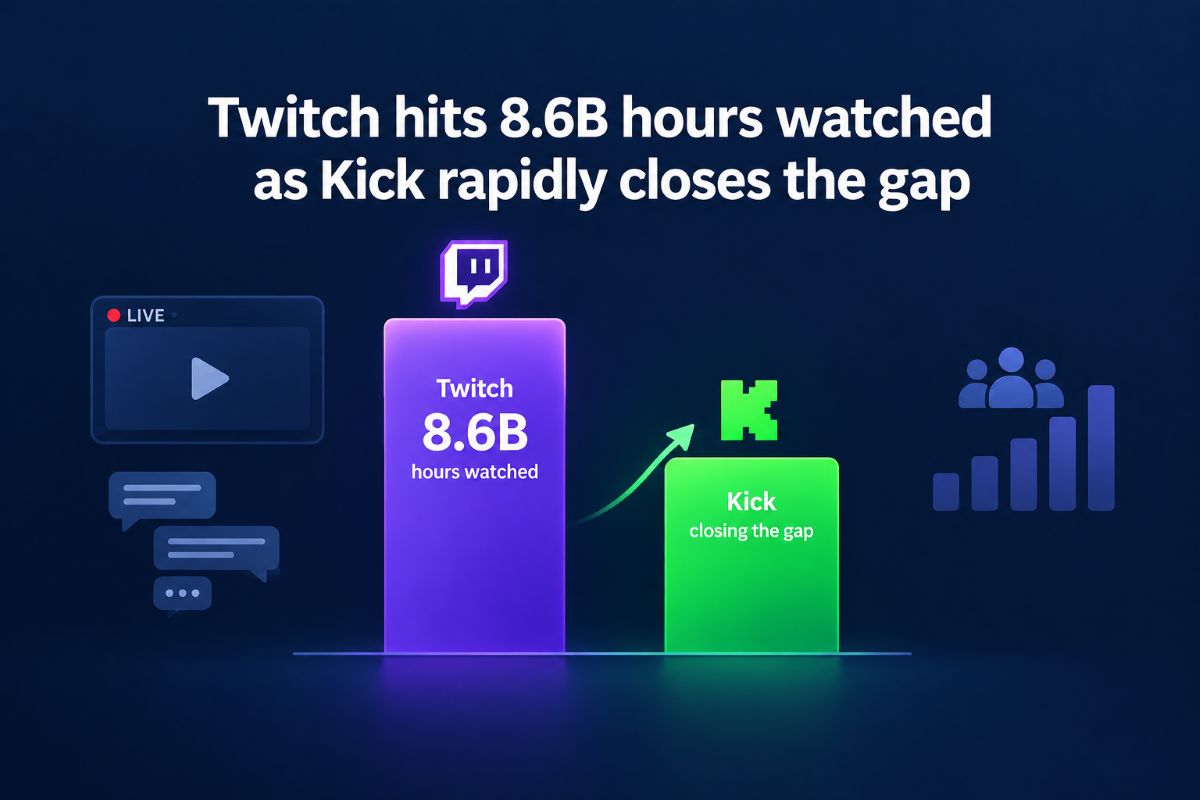
Twitch has recorded more than 8.6 billion hours of gaming watched in the first eight months of 2026, underlining just how large the livestreaming platform remains. But rival Kick is growing rapidly, raising a bigger question for viewers and creators: is Twitch’s dominance beginning to weaken? (Twitch Blog)
What’s actually true
The 8.6 billion figure comes directly from Twitch’s State of Gaming 2026 report. It covers global viewing between 1 January and 1 September 2026, rather than all Twitch content or the entire year. Twitch says the figure represents gaming content alone. (Twitch Blog)
The platform’s five most-watched games — League of Legends, Counter-Strike, GTA V, VALORANT and World of Warcraft — generated nearly 1.7 billion hours between them. Twitch also reported strong engagement with Drops, with Drops-enabled streams accounting for 1.6 billion hours watched. (Twitch Blog)
That makes the headline impressive, but it should not be interpreted as Twitch having 8.6 billion hours of unique viewers. Hours watched measures total viewing time, so the same person can contribute many hours.
There is another important distinction. Twitch’s 8.6 billion figure is not directly comparable with every Kick statistic published elsewhere because measurement periods and methodologies differ.
How this connects to Kick
This is where the story becomes more interesting.
Independent livestreaming data indicates that Kick is growing faster in percentage terms, albeit from a much smaller base. Streams Charts reported that Twitch still generated roughly three times Kick’s hours watched during the second quarter of 2026, but the gap was closer to five times a year earlier. (Streams Charts)
Kick’s growth has also been visible month by month. Streams Charts reported a record June for the platform, with 570.7 million hours watched, helped partly by a major Rust campaign. (Streams Charts)
That does not mean Kick is about to overtake Twitch. It means the competitive landscape is changing, with creators and viewers increasingly having another major livestreaming platform to choose from.
For UK viewers, the practical effect is fairly simple: the biggest streamers, gaming communities and live events may increasingly be spread across multiple platforms rather than concentrated in one place.
The biggest misconceptions
“Kick is catching Twitch, so Twitch must be losing viewers.”
Not necessarily. A rival growing quickly does not automatically mean the larger platform is collapsing. The available data shows Kick gaining ground while Twitch remains substantially larger. (Streams Charts)
“8.6 billion hours means 8.6 billion people watched Twitch.”
No. Hours watched is a measure of viewing time, not unique people.
“Kick growing faster means it is already bigger.”
Percentage growth needs context. A smaller platform can grow considerably faster while still having fewer total hours watched.
“All streaming statistics can be compared directly.”
This is another common trap. Twitch’s 8.6 billion figure covers gaming from January to September, while third-party Kick figures may cover individual quarters or different categories.
What should viewers and creators do next?
For viewers, there is no immediate need to change anything. Twitch and Kick can coexist, and many people will simply follow individual creators wherever they stream.
Creators have a more significant decision. Platform choice can affect discoverability, monetisation, audience demographics, moderation and community culture. Anyone considering a move should check the current terms and revenue arrangements directly with each platform, rather than relying on older social-media claims.
The next useful indicator will be whether Kick can sustain its growth over several quarters, particularly during periods without major events or promotional campaigns.
The takeaway
Twitch’s 8.6 billion gaming hours watched confirms that it remains a huge force in livestreaming. At the same time, Kick’s faster growth and narrowing gap show that the market is becoming more competitive. (Twitch Blog)
The simplest conclusion is not that Twitch has been overtaken. It is that viewers and creators now have a more credible alternative — and that could increasingly shape where livestreaming goes next.
