


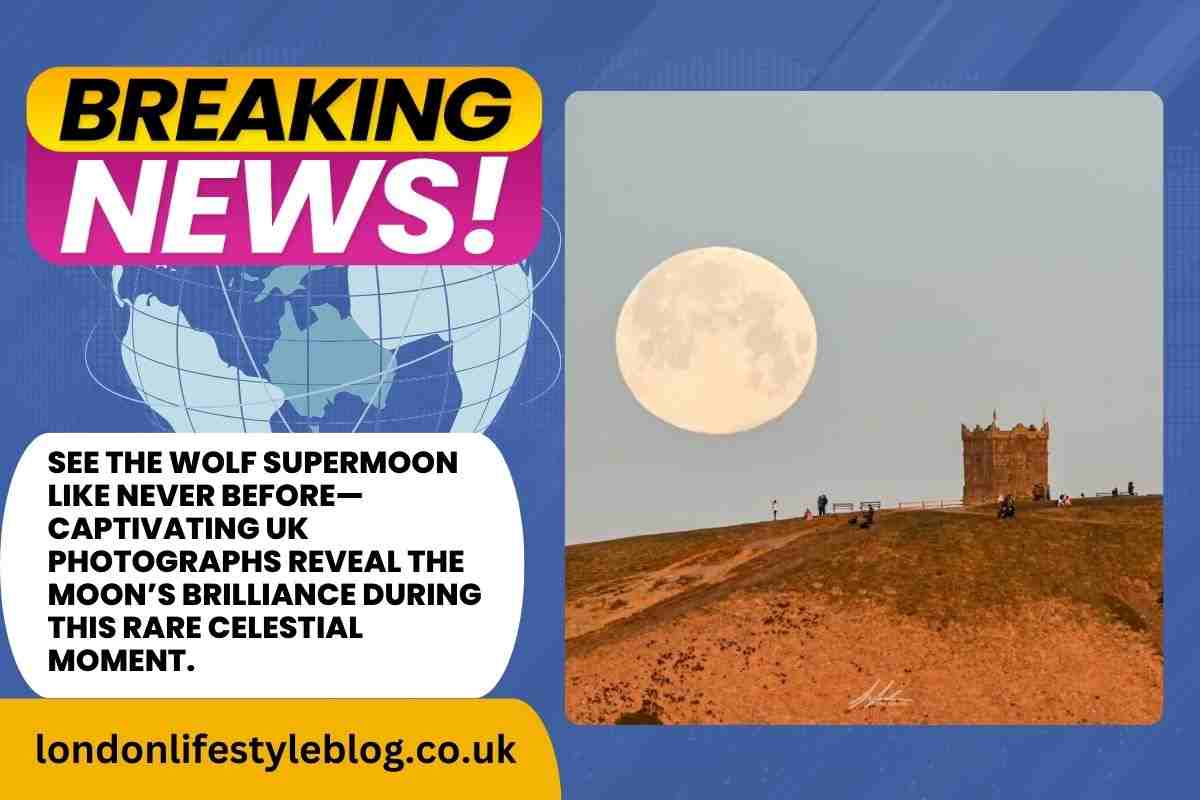
The Supermoon, the first full Moon of the year, which happened in the UK skies over the weekend, was a magnificent sight to behold as people in most parts of the land observed its movement.
Although the weather was cold, people who viewed the heavenly spectacle, which is the Wolf Moon, had good visibility.
The Royal Observatory in Greenwich justifies the choice of name by the fact that hungry wolves would howl seeking food in the middle of winter.
On Saturday morning, strikingly clear photos were taken at Stonehenge, Wiltshire, in southwest England, and the setting sun was the Supermoon.
Subsequent photographs depicted it rising over Glasgow, Scotland and the Thane Estuary, Minster, Kent, in the southeast.
The Royal Observatory in Greenwich said that the Wolf Moon was at full at just after 10 am on Saturday.
Many people have temperatures below freezing overnight, and it was still lower, 0 Degree Celsius, after 10 am. The southwest of England and west Wales had been warmer and had even attained 4 °C by the time the moon rose.
It was a Supermoon, a full moon that is closest to the earth in its orbit- that is, it is up to 14 per cent larger and 30 per cent brighter than it appears at its most distant.
Friday, Jess Lee, an astronomer with the Royal Observatory Greenwich, said: “Every full moon throughout the year has its own unique nickname.
“The January full moon is often called the Wolf Moon, a name inspired by wolves that were thought to roam during the long winter nights.”
She added, “You don’t need any special equipment or to escape light pollution to enjoy the view; it’s a beautiful sight in cities and rural areas alike. “
