


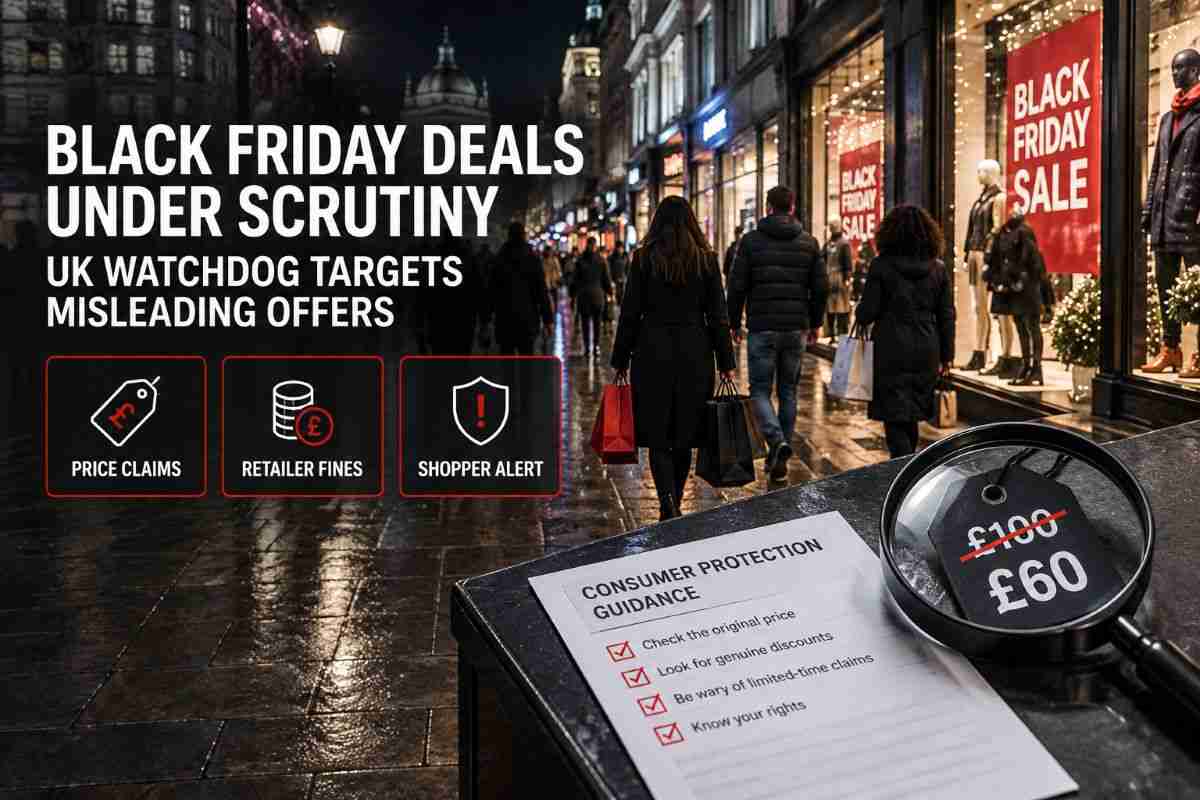
Black Friday is meant to help shoppers save money, but how can you tell whether a discount is genuine or simply a clever pricing trick? With millions of pounds in penalties imposed on businesses for misleading sales tactics and fresh questions being raised about Black Friday promotions, UK shoppers are being urged to look beyond the percentage-off labels before buying.
The concern is not that every Black Friday deal is misleading. It is that some retailers have used pricing claims, countdown timers and promotional tactics that can make an offer look better or more urgent than it really is.
What’s actually true: Why retailers are facing penalties
The Competition and Markets Authority (CMA), the UK’s competition watchdog, announced on 14 October 2026 that three businesses had been fined a combined £6 million for misleading sales practices. The cases involved online retailer Wayfair, Appliances Direct and Gold’s Gym. GOV.UK+1
Wayfair received a £4.8 million penalty after the CMA found that its website used supposedly time-limited Daily Deals and Flash Deals that did not genuinely end when advertised. Some products remained available at the same price, or became cheaper, after the countdown had expired.
Appliances Direct was fined £1.2 million. The watchdog found that its website repeatedly displayed countdown promotions offering discounts of £10 to £25, even though the same discount codes appeared over several days. It also found that some customers were automatically signed up for paid extras without giving their express agreement.
Gold’s Gym received a £45,000 fine for failing to make mandatory membership joining fees sufficiently clear in its advertised prices.
The CMA also ordered refunds totalling around £440,000 for affected Appliances Direct and Gold’s Gym customers. These cases demonstrate that misleading promotions can involve more than simply displaying an inflated original price.
Black Friday 2026: Fresh concerns over misleading discounts
The issue has attracted further attention following a parliamentary hearing on 3 November 2026, where MPs questioned consumer protection officials about misleading Black Friday promotions.
During the hearing, the CMA’s Executive Director for Consumer Protection, Emma Cochrane, confirmed that the regulator had opened investigations into 20 businesses, closed seven cases and imposed £12 million in fines under its strengthened consumer enforcement powers.
One particularly striking example raised by MPs involved a Samsung vacuum cleaner. It was reportedly advertised at £299 between May and June, increased to £399 between August and September, and then presented at £350 as a Black Friday deal.
The committee also heard Which? representative Sue Davies say that around 80% of products scanned in its research did not offer a genuine Black Friday discount. This was a figure cited during the hearing, rather than a finding that should be applied to every retailer or Black Friday product. 03 Nov 2026+1
There have also been advertising rulings involving John Lewis, Boots and Debenhams. In May 2026, the Advertising Standards Authority (ASA) found several Black Friday price claims misleading because the retailers had not provided sufficient evidence of the advertised savings. The affected adverts were banned, rather than the retailers being fined millions in those cases. ITV News+1
What protection do shoppers actually have?
The Digital Markets, Competition and Consumers Act 2024 strengthened consumer protection enforcement powers from April 2025.
Under the rules, businesses must not mislead customers with false claims about savings, availability or limited-time promotions. They must also display mandatory charges clearly in the total price rather than revealing them unexpectedly during checkout.
For example, a retailer cannot legitimately advertise a promotion as ending within hours if the same offer continues beyond the stated deadline in a way designed to pressure customers into buying immediately.
Similarly, a crossed-out price should represent a genuine established selling price. Retailers should be able to provide evidence supporting their advertised savings claims. The ASA considers factors including pricing history, sales information and how long the product was available at the higher price. GOV.UK+2
Common Black Friday discount mistakes
Shoppers can easily mistake a large percentage reduction for a genuine bargain. However, there are several things worth checking:
- Assuming every discount is genuine: A 50% reduction does not automatically mean the product is half its normal selling price.
- Trusting countdown timers: An urgent message does not necessarily mean the promotion will disappear when the clock reaches zero.
- Ignoring previous prices: A product’s price history can reveal whether its advertised original price was genuinely established.
- Overlooking additional charges: Delivery, installation and other compulsory costs can make an apparently attractive offer less worthwhile.
- Confusing an RRP with the usual selling price: A manufacturer’s recommended price does not necessarily reflect what customers normally pay.
Importantly, there is no simple rule that every Black Friday discount must be compared with a price charged for exactly 30 days. The overall pricing history and circumstances matter.
What should shoppers do before buying?
Before committing to a Black Friday purchase, consider these practical steps:
- Check historical prices: Use price-tracking services such as PriceRunner or CamelCamelCamel, where available, to see how the product’s price has changed.
- Compare different retailers: Check the exact model number rather than comparing products that look similar.
- Save evidence: Take screenshots of advertised prices, discount claims and checkout totals if something appears misleading.
- Read the final checkout price: Look for delivery charges, optional extras and any additional payments before confirming an order.
- Report misleading promotions: Consumers can raise advertising concerns with the ASA or seek advice from Citizens Advice about potentially unfair trading practices.
The bottom line
Black Friday still offers genuine opportunities to save money, but a large discount label is not proof of a good deal. Recent CMA penalties, advertising rulings and parliamentary scrutiny show why shoppers should check price history, compare retailers and resist artificial pressure to buy immediately.
The simplest approach is to know what a product normally costs before deciding whether its Black Friday price is worth paying.
